






























In the multibillion-dollar industry of National Collegiate Athletic Association football, the annually awarded Heisman Trophy is arguably the most prestigious individual athletic accolade. Like the Ballon d’Or, or other sports’ most valuable player, this award highlights the best of the best. Finalists are often indicators of the future success stories in the NFL. Other than winning the college football national championship, winning the Heisman trophy is the next best thing for players.
The Heisman trophy is the award given to the best college football player of the regular season. It is voted on by various sports journalists across the country and by the former Heisman winners themselves.
The Heisman trophy usually rewards offensive achievement, hence quarterbacks or running backs tend to be the frontrunners. However, last year, the winner, Travis Hunter, played two positions almost equally, cornerback and wide receiver, with 92 receptions, 14 touchdowns, 31 tackles, and four interceptions at the University of Colorado, Boulder (CU).
For anyone who does not watch college football, doing this in only 11 games is very impressive. However, unlike two out of the four finalists that year, Dillion Gabriel (quarterback at the University of Oregon) and Ashton Jeanty (running back at Boise State University), Travis Hunter’s team, the Colorado Buffaloes, did not make the playoffs. In fact, out of the last five Heisman winners, only two made the playoffs.
Moreover, there has not been a Heisman winner who has made the college football playoffs in four years. This year, the finalists consist of three quarterbacks and one running back: Fernando Mendoza (quarterback from Indiana University), Julian Sayin (quarterback from Ohio State University), Diego Pavia (quarterback from Vanderbilt University) and Jeremiyah Love (running back from the University of Notre Dame).
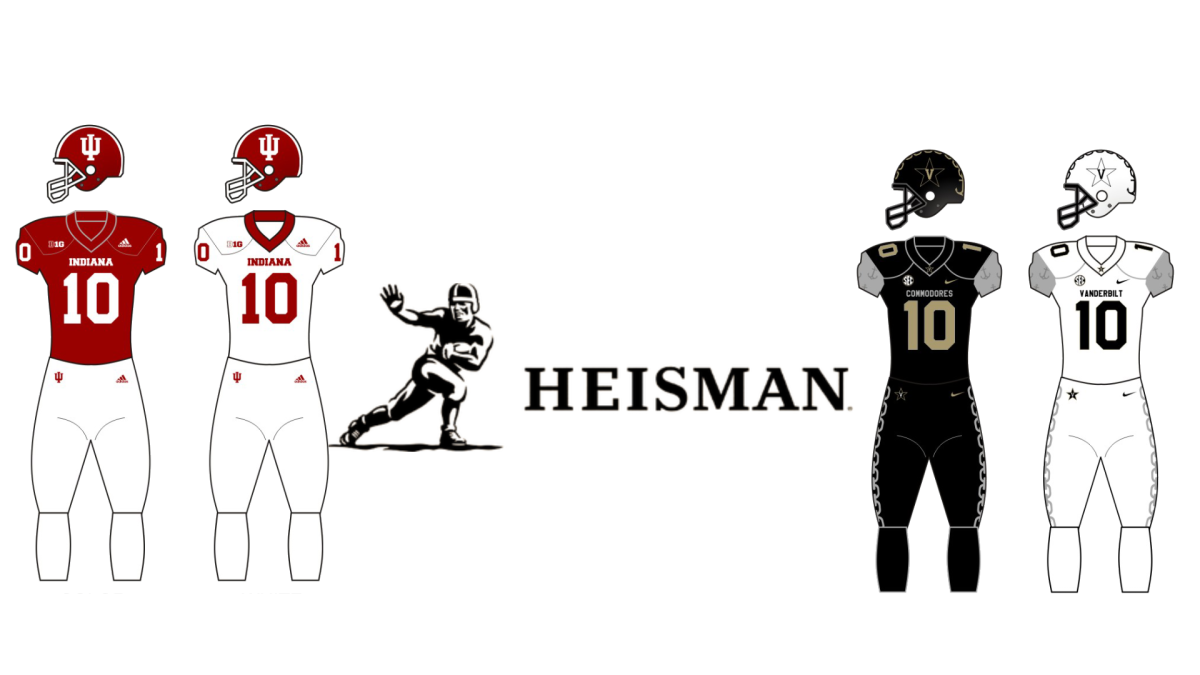
I believe that this year’s result will be different, as the frontrunner of this race is the quarterback of the number one team in college football, the Indiana Hoosiers. According to the official odds presented by FanDuel sportsbook, Mendoza is the favorite by -2000, with Vanderbilt quarterback Diego Pavia in second place with +900.
Although a player’s statistics are an important factor in determining who sports journalists and former Heismans will select, the narrative behind the player’s season, as well as their “Heisman moment” (their moment on the field that is worthy of the Heisman), is also vital for determining the top college football player of the year. Both players have interesting narratives to follow.
Diego Pavia, a senior quarterback who started playing at the Junior College level only several years ago, has now led Vanderbilt University to a 10-2 record, defeating ranked teams such as the number 19-ranked Tennessee Volunteers, the number 11 South Carolina Gamecocks, and the number 10 Louisiana State University (LSU) Tigers.
Even though Vanderbilt lost to the number 20 Texas Longhorns, the score was 34-31, and Pavia threw for 365 yards, his second most of the season. Although the Commodores (Vanderbilt) did not make the final twelve-team playoff this year, they will play the University of Iowa Hawkeyes in the ReliaQuest Bowl in a high-ranking bowl game on Dec. 31.
Along with notable wins and a phenomenal senior year in Nashville, Pavia finished the regular season tied for the eighth-best completion percentage in all of Division 1 college football, completing 71.2 percent of his passes. He also had the nation’s fourth-best passer efficiency rating (RTG) below Mendoza and Sayin.
Although a player’s statistics are taken into account by the voters of the Heisman trophy, it’s often the more visible moments of a player’s brilliance on the field that captivate their attention and capture their vote. For example, leading the historically weaker team of the Vanderbilt Commodores to defeating the University of Tennessee by over twenty points is not something that goes unnoticed.
Fernando Mendoza, a redshirt junior (a senior in college who didn’t play any games for one season, and therefore has an extra year of eligibility) at Indiana University, recently completed his first regular season with the Hoosiers. Before Bloomington, he lived in Berkeley, California, attending the University of California, Berkeley (Cal), and playing for the Cal Golden Bears for two seasons. Mendoza’s familial background is also interesting, as his grandfather emigrated from Cuba to Miami, where Mendoza grew up.
He would be the first Cuban-American to win the Heisman trophy, and only the third player of Latinx descent to do so. Mendoza brings diversity into the equation, furthering his interesting campaign and narrative to win the Heisman in New York City this Saturday, Dec. 13. Statistically, Mendoza had the second-highest passer efficiency rating, only behind Julian Sayin, the sixth-best completion percentage, and the most touchdowns in college football this year.
To top it off, he led the Hoosiers to a 12-0 record before the Big 10 championship game, and under his guidance, the Hoosiers defeated the best team in the country, the Ohio State Buckeyes, to clinch the number one seed for the playoffs.
This year’s Heisman race may swing inMendoza, but only time will tell. It is still possible that the voters will surprise everyone and choose Julian Sayin or Jeremiah Love.
Author’s Opinion
Both quarterbacks are extremely skilled players and deserving candidates for the Heisman trophy this season. However, I believe that Mendoza should win this year not only because he consistently recorded better stats than Pavia, but also because of the three top ten wins that Indiana had this season, even bettering the number one team in the nation, Ohio State, in the Big 10 conference championship. Moreover, they are the only number one team remaining now. Therefore, Mendoza’s catalogue makes him the choice for this year’s Heisman trophy.
By Carter Samuel

