
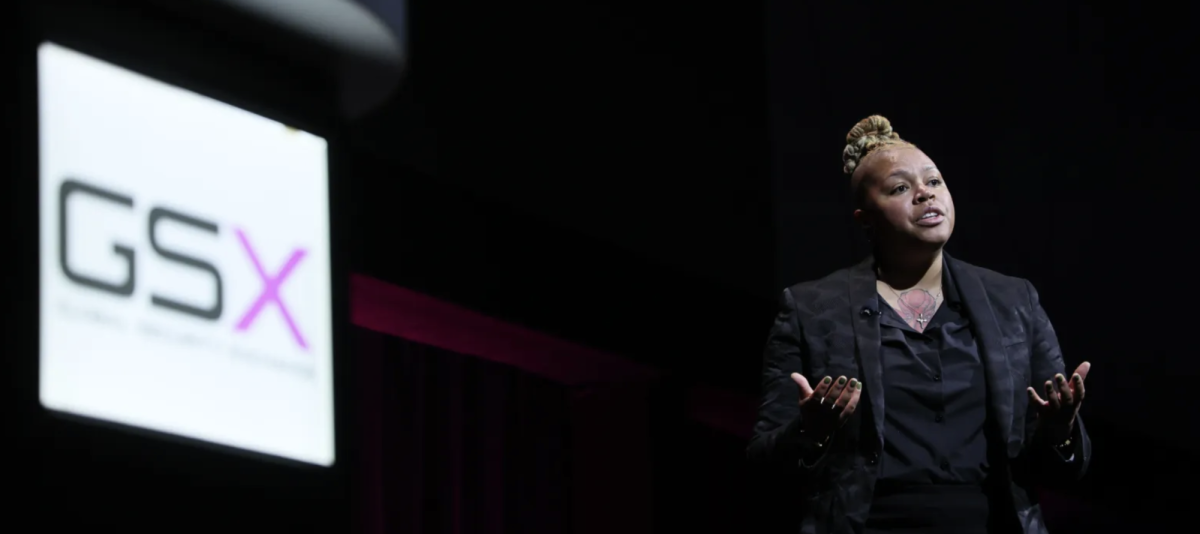






































February 11 is not just a landmark moment in Black History Month — marking Nelson Mandela’s release from prison in 1990 after 27 years, a turning point in the end of South African apartheid — but also a notable day for the WIS community. On this day, speaker Charity Blackwell took to the stage at the Upper School assembly.
Graduating from Trinity University with a B.A. and M.A. in Communications, Blackwell rapidly began carving out space in the spoken word world with authenticity and fire. Her award-winning spoken work as a word artist, poet and educator has allowed her voice to resonate far beyond the stage.
Now, as a diversity, equity and inclusion practitioner, host, emcee and poetry specialist, Blackwell has spent years shaping the arts and culture scene both on a national scale and locally in Washington, D.C. She also serves as Senior Advisor of Arts and Culture at DC SCORES and Director of Poetry Events (D.O.P.E.) at Busboys and Poets. Across her fields of expertise, her work has appeared on platforms including BBC News, TEDxTysons, the National Basketball Association, the Women’s National Basketball Association, Major League Soccer Network, the Kennedy Center and the Lincoln Theater, among many others.
During assembly, Blackwell gave a memorable and meaningful presentation, taking students on a journey through her words as she began by explaining her primary medium of performance: spoken word.
“Poetry is the written piece […] It’s meant to be written; it’s meant to be read,” Blackwell said. “Spoken words are poetry, but it lives in a different place.”
Blackwell went on to explain the history of spoken word, and its important cultural ties to Black history.
“Spoken words come from a time before written,” Blackwell said, describing how hereditary West African historians, storytellers and musicians called Griots were dedicated to preserving oral traditions, passing history down by word of mouth for centuries before the written medium was popularized.
Then, when Africans were enslaved and brought to America, speech became the one thing that they were unable to lose, as oral history continued for countless generations.
“When paper was forbidden, they sang for freedom,” Blackwell said.
Since then, spoken word has evolved further, yet it remains rooted in ancient times. Because of that, so many things can be traced back to the spoken word: “Black history didn’t just start on paper, it started in someone’s mouth,” Blackwell said.
But spoken word is more than just the words that are produced from someone’s mouth. It’s more than just the tone and inclination of the verbalized words.
“Spoken word is created to be heard; it lives in your breath, your tone, your body movement,” Blackwell said.
Blackwell then shared three extraordinary examples of her own work, beginning with a powerful and emotional retelling of her own past in a spoken word poem titled “Soccer and Poetry”. Afterward, Blackwell expanded on the connection between spoken word and history in general.
“When I perform poetry, I’m not just telling my story; I’m carrying pieces of my parents,” Blackwell said, “my grandparents, people whose names were never written down.”
Then she delivered another poem, titled “Trailblazers”, inspired by the backlash Blackwell witnessed black female athletes receive simply for expressing themselves. Through this piece, she delivered a striking commentary on the expectation placed on Black women to carry themselves a certain way, to remain “quiet”, and not complain. But, as Blackwell asserts, “resilience is always loud.”
Her next poem, “Shaq”, returned to Blackwell’s personal experience, describing her complex relationship with her father through one basketball game and a free throw. Blackwell recalls that her father didn’t attend her plays, soccer games, or performances, but always came to her basketball games and was “front and center, always there.” This shared interest allowed her to navigate their complicated bond, culminating in a remarkable poem and an even more astounding performance.
Her last poem, conversely, was dedicated to her mother, titled “The Gift of Giving”. The poem explored the meaning of her first name, “Charity,” and the benefit of guiltless giving.
Finally, Blackwell encouraged the WIS community to reflect on these passions and what gives them power. She explored how poetry has changed her, giving her “language, and permission to feel everything [she] was feeling.”
“Your passion might not look like mine,” Blackwell said, “but whatever you love can be the thing that carries you through these feelings.”
By Mahina Diaz-Asper

